


8月26日,微软联合创始人比尔·盖茨就AI对就业和人类生存状况构成的风险发出严厉警告,称各家公司正在鲁莽推进这项技术,却没有为其将引发的巨大动荡制定任何宏观计划。
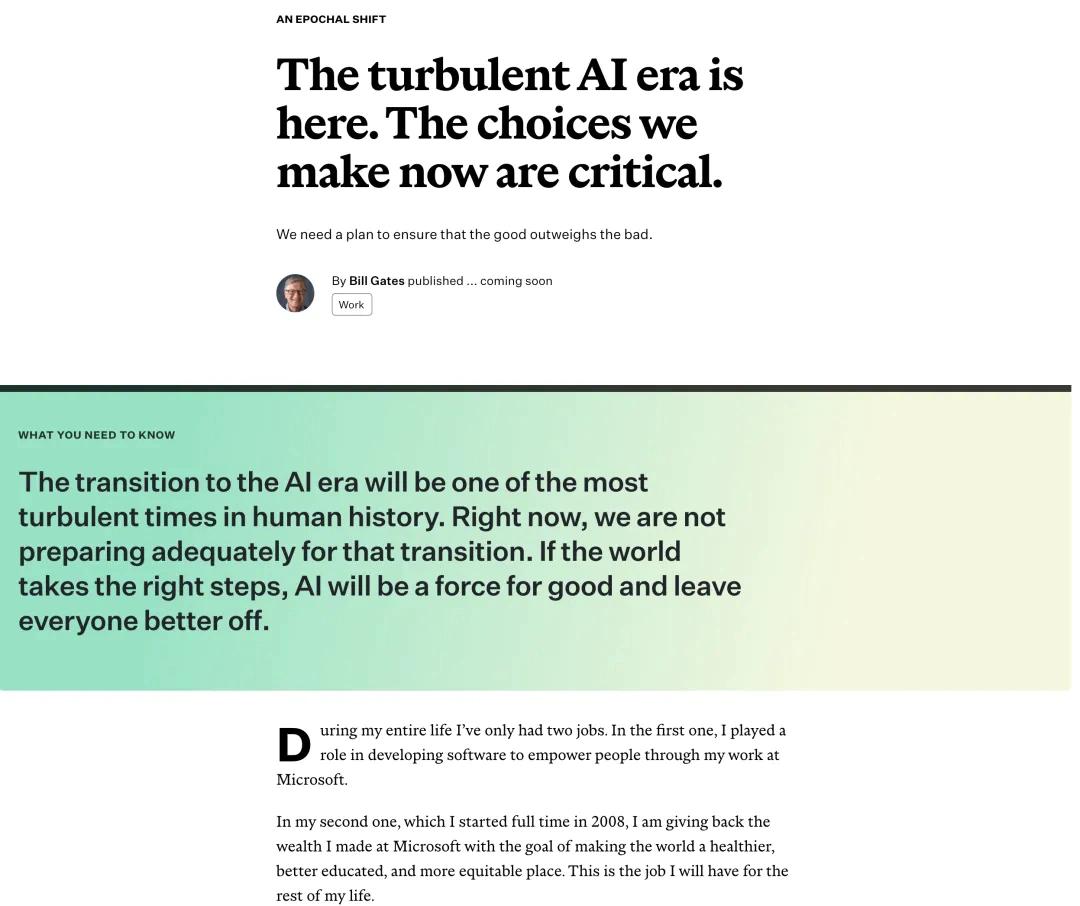
盖茨周三在其个人网站上发表了一篇12页、长达5784字的文章,标题为《动荡的AI时代已经到来。我们现在所做的选择至关重要》。
他表示:“即使在最理想的情况下,向这个新AI时代的过渡也将是人类历史上最动荡的时期之一。目前,我们并未为此做好准备。我没有看到任何迹象表明,各国领导人、专家和社区正在充分应对这些挑战。”
这篇文章比盖茨2023年所写的AI长文更为清醒。在那篇文章中,他曾写道,他对这场革命的兴奋程度不亚于互联网和个人电脑的普及。尽管周三的这篇长文强调了AI在能源、医疗和农业等领域带来的巨大潜力,但他也强调,如果这一转型管理不善,后果可能有多严重。
“目前没有任何计划来帮助我们平稳进入AI时代。”他写道,并呼吁加强对这项技术的监管。
盖茨私人办公室Gates Ventures的一名代表表示,盖茨之所以选择现在发声,是因为他认为留给人们为这一转型做准备的时间已经不多了。
盖茨在文章中还提到,他将在华盛顿与国会议员就AI技术展开讨论:“在失业率急剧上升、社区遭受重创、公众信任被侵蚀之前,你们现在还有机会采取行动。”
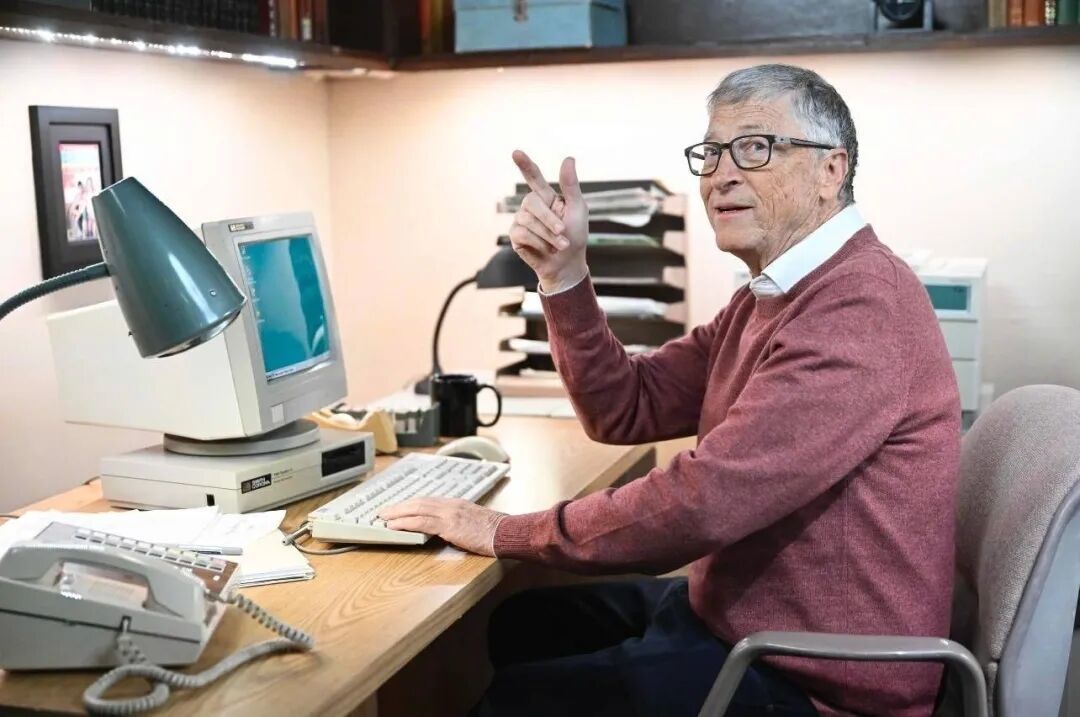
图片来源:比尔·盖茨微博
以下是盖茨长文的三大要点:
AI将很快冲击白领和蓝领工作
盖茨文章的大部分篇幅都在讨论就业问题。盖茨指出,初级和中级岗位最有可能被AI取代。他认为,AI很快也会影响蓝领工作,其影响范围之广、速度之快,将使这次职场转型不同于以往。虽然从农业转向办公室工作用了数代人的时间,但法律、客户服务、软件和制造业等行业将在十年内感受到AI的影响。
盖茨写道,当AI能够产出零差错的工作时,“它将能够独立运作,无需人工检查,而企业将有充分的经济动机放手让它去做”。
他指出,一个失业人口多得多的社会将需要更强大的社会保障体系。当工厂关闭时,许多当地人死于阿片类药物过量,“想象一下,如果全国各地的白领和蓝领工人都面临类似的压力呢?”
批判性思维的重要性
盖茨强调了电网、医院和银行面临的网络攻击风险。欺诈和监控将变得无处不在。他写道,AI还将使政府能够在没有人类参与决策的情况下使用致命武力。
谈到人与人的关系时,盖茨强调,AI可能会形成一个信息茧房,这可能对儿童产生深远影响。聊天机器人具有成瘾性,可以成为一种毫不费力的陪伴方式,并可能削弱人们的批判性思维能力。
“现在是人类最不能失去批判性思维能力的时候,”他写道,“在一个充斥着深度伪造和量身定制虚假信息的时代,辨别真伪的能力成为一项至关重要的生活技能。”
税收是解决方案的一部分
盖茨呼吁对AI词元和机器人征税。此举可以延缓企业抛弃人类劳动力的步伐。这些税收也可用于资助社会保障体系,为那些工作将不复存在的人提供再培训。他指出,这笔资金可以弥补个人所得税收入的减少(如果工作的人减少,个人所得税收入将缩水),从而帮助政府维持公共服务。
盖茨的政策建议
1. “Human Reserved(人类保留岗位)”制度
类比自然保护区,部分岗位即便AI技术可以完成,也要刻意留给人类。典型场景:临终病情告知、照护、教育、心理咨询。不是完全禁止AI介入行业,而是限定行业内部分核心职能必须由人完成;他估算最多约40%岗位可以采用该模式保护。
2. 对AI算力Token与机器人征税
现在企业雇佣人类需要缴纳工资税,但采购AI、人形机器人可以做商业抵扣,这在制度上激励企业用机器替代人。应当对AI调用单元、机器人征税,税收用于失业人员再培训与社会保障。
3. 建立跨国监管机构
拒绝完全交由行业自我监管,需要国家级、国际性机构统筹AI在就业、税收、安全、教育领域的治理,中美等大国需要开展合作。
【以下是经AI翻译原文】
动荡的 AI 时代已经到来,当下选择至关重要
作者:比尔・盖茨 原文发布平台:盖茨笔记 Gates‑Notes,2026‑08‑26GatesNotes
译文说明:盖茨官方并未发布中文版译文,以下为忠实于英文原稿的完整人工译本。
一个划时代的转折
动荡的 AI 时代已经到来,我们当下做出的选择至关重要。 我们需要制定一份方案,确保人工智能带来的利大于弊。
在我的一生当中,我只从事过两份事业。第一份事业,是在微软开发软件,用技术赋能普通人。 第二份事业始于 2008 年,自此我全身心投入公益,回馈在微软积累下的财富,目标是让世界变得更加健康、教育更加普及、社会更加公平。这份事业,将会伴随我的余生。
两段截然不同的经历,共同塑造了我看待人工智能的视角。13 岁第一次接触计算机时,我便深深着迷于一个想法:让机器变得智能,完成那些在当时只有人类才能做到的事情。尽管 “人工智能” 一词早在我出生前后就已经出现,但这项技术直到过去十年才迎来实质性飞跃。如今 AI 能力已经达到令人惊叹的水平,并且还在以超乎想象的速度迭代进步。人工智能第一次有能力取代,甚至超越人类的认知能力。
从社会公平的角度看,人工智能要么会成为人类有史以来最强大的均衡器,要么就会成为不公现象最大的来源。我们面临的挑战无比艰巨。即便一切都朝着最理想的方向发展,迈向全新 AI 时代的转型过程,也将会是人类历史上最为动荡的时期之一。我们应当如何利用这项技术,建设一个更加公平的世界,防止它进一步拉大贫富鸿沟?我们该如何保护最容易受到 AI 伤害的群体,包括那些失去生计、对未来丧失掌控感的人们?
我坚信,回答好这些问题,并落实对应的行动,应当成为全世界的首要任务。如果各国采取正确举措,人工智能就可以成为向善的力量,让所有人的生活变得更好。
遗憾的是,当下我们并没有为此做好准备。我没有看到任何迹象表明,各国领导人、行业专家以及广大社会群体,正在充分应对眼前的挑战。企业正在快速推进人工智能落地,却几乎没有任何宏观计划,用来应对这场转型带来的巨大冲击。如果任由目前的趋势发展下去,人工智能带来的负面后果极有可能超过正面收益。
接下来,我将说明为什么我认为风险如此严峻,同时也会阐述 AI 蕴藏的巨大机遇,最后提出一套我认为世界应当采纳的行动方案。
人工智能带来的三大核心风险
我看到三大风险正同步显现,并且它们之间会互相放大。
第一,大量岗位将会永久性消失。 人工智能与工业机器人的结合,会替代许许多多由人类完成的工作。最先受到冲击的,是大量初级、中级白领岗位,例如客服人员、初级程序员、法务助理等。到 2030 年前后,建筑行业、服务业也将迎来机器人替代浪潮。年轻人将会受到最严重的冲击。当岗位永久性消失,仅仅依靠劳动者再培训并不足以解决问题。我们需要思考,当一部分工作永远不复存在时,社会应当如何保障民众的收入与尊严。
三年之前,我曾经认为就业市场受到的冲击只是短期颠簸,整体转型过程尚可管理。如今我的看法已经发生改变。岗位流失的规模,将会远远超出我们此前的预期。
第二,人工智能降低了作恶的门槛。 过去想要开展网络攻击、传播大规模虚假信息、设计危险病原体,都需要极高的专业能力。如今借助 AI,能力有限的个人也可以完成上述行为。深度伪造视频、自动化网络欺诈、针对电网、医院等关键基础设施的攻击,都将变得更加容易实施。人工智能既能加速疫苗研发,也可以辅助制造危险病原体,造福人类的能力和伤害人类的能力,很难被完全分割开来。
第三,人工智能可能伤害儿童成长,侵蚀人与人之间真实的人际关系。 多项来自斯坦福大学、卡内基梅隆大学的研究表明,长期和 AI 角色互动,会削弱孩子与真人交往的社交能力。当人们越来越多把时间花在人工智能陪伴之上,人与人之间深度联结的机会就会变少。孩子成长阶段缺少真实人际互动,将会对其共情能力、心智发展造成长远影响。
上述风险并不是遥远的未来问题,它们已经出现在当下。
人工智能蕴藏着前所未有的巨大机遇
尽管风险十分严峻,但我仍然坚信人工智能是一股强大的向善力量。它可以为医疗健康、农业生产、清洁能源、基础科研、公共服务等领域,带来革命性突破。
盖茨基金会计划使用人工智能,加快攻克疟疾、艾滋病、儿童营养不良等全球性难题。在低收入国家,AI 可以帮助基层医务工作者诊断疾病;AI 农业工具能够帮助小农户应对气候变化,提高粮食产量;清洁能源研发,也可以借助人工智能大幅提速。
人工智能本可以成为缩小鸿沟的工具,让教育、医疗、创业资源惠及全世界更多普通人。但这份红利不会自动普惠大众。如果放任市场自由发展,AI 资源将会优先流向富裕人群,进一步扩大不平等。政府与公益组织必须主动介入,引导人工智能朝着缩小差距的方向前进。
面向 AI 动荡时代的三大行动建议
为了尽可能放大收益、降低风险,我呼吁全世界采取三项关键行动。
第一,建立全球协同的 AI 治理框架
人工智能没有国界,风险同样会跨越国境。这项前所未有的新技术,需要前所未有的全球性应对方案。治理工作不能仅由科技企业自行决定。各国政府、科研院校、公益组织、劳动者代表,都应当坐到谈判桌上,共同制定规则。不同国家发展阶段不一样,监管政策也应当因地制宜,但各国之间必须建立常态化对话机制,防止监管套利。
第二,划定 “人类工作保留区”
有一部分工作,即便人工智能从技术层面完全可以胜任,我们仍然应当保留给人类完成。尤其以照护类岗位为代表,护士、社工、心理咨询师、教师等充满人文情感的工作,真人之间的信任与共情无法被机器替代。划出人类专属工作领域,可以缓冲大规模失业浪潮,守护人与人之间的温情纽带。
第三,调整税收机制,建设社会保障安全网
各国应当探讨对 AI 算力调用(Token)、工业机器人等自动化工具征税。税收的目的,是提高企业单纯依靠机器替代人力的经济成本,所得税收投入劳动者再培训项目、失业保障、普惠福利体系。
技术进步带来的繁荣成果,应当由全社会共享,而不是仅仅流向少数资本所有者。
结语
在过去几十年,面对每一项创新技术,我始终希望它跑得更快一些。 而人工智能,是我第一次希望一项新技术放慢前进速度。我们需要充足的时间,完成社会、经济、政治层面的各项准备,平稳度过这场转型阵痛。
动荡的 AI 时代已经到来,而当下我们做出的选择,将会定义人类的未来。
【以下是英文版原文全文】
The turbulent AI era is here. The choices we make now are critical.
We need a plan to ensure that the good outweighs the bad.
Make AI Work For Everyone
WHAT YOU NEED TO KNOW
The transition to the AI era will be one of the most turbulent times in human history. Right now, we are not preparing adequately for that transition. If the world takes the right steps, AI will be a force for good and leave everyone better off.
During my entire life I’ve only had two jobs. In the first one, I played a role in developing software to empower people through my work at Microsoft.
In my second one, which I started full time in 2008, I am giving back the wealth I made at Microsoft with the goal of making the world a healthier, better educated, and more equitable place. This is the job I will have for the rest of my life.
Both of these experiences inform my perspective on artificial intelligence. When I first learned about computers at age 13 I was fascinated by the idea of making them more intelligent and able to perform things that, at the time, only humans could do. Although the term “AI” was used from around the time I was born, the technology has only made significant progress in the last decade. It is now incredibly capable and it is continuing to improve at a mind-blowing rate. AI for the first time can replace and even exceed human cognition.
AI will either be the greatest equalizer ever invented, or the worst source of injustice.
In terms of equity, AI will either be the greatest equalizer ever invented, or the worst source of injustice. The challenge is monumental. Even under the best circumstances, the transition to this new AI era will be one of the most turbulent times in human history. How will we use this technology to make the world a fairer place and keep it from widening the divide between rich and poor? How will we protect the people who are most vulnerable to the harms caused by artificial intelligence, including those who lose their livelihoods and the sense that they are in control of their future?
I believe that answering these questions and acting on the answers should be the world’s top priority. If the world takes the right steps AI will be a force for good and leave everyone better off.
Unfortunately, right now we are not preparing for it. I don’t see evidence that leaders, experts, and communities are confronting the challenges adequately. There is no plan to ease the entry into the AI era.
Part of the reason for this is that many commentators underestimate the extent of the impact AI will have. I think there are a few reasons why.
One is the fact that AI models still make mistakes. It is hard to envision any of them replacing human cognition when, not long ago, they couldn’t solve a simple Sudoku puzzle or figure out how many R’s are in the word strawberry.
But the reliability problem is being fixed quickly, as researchers create models that can check their own work and improve themselves. Soon they will be substantially better than humans at many tasks.
Another reason people underestimate AI is that analogies to the effects of past innovations are misleading. We have no experience with a technology that can be adopted quickly or that can think and move like a human. When the PC came along, it took twenty years to significantly change how we worked because the software had to be developed, the price had to come down, and people had to learn how to use the tools and incorporate them into their business processes. AI, on the other hand, runs on the devices we already have, and it uses natural language. We don’t have to adapt to it because it can adapt to us. It can watch the same training video that is used to train human workers and learn from existing data.
I want to acknowledge a potential bias. I have benefited enormously from the technology industry. Although I have diversified my portfolio quite a bit, I still have financial ties to it. I am working with Microsoft and other AI companies in my role as chairman of the Gates Foundation to try and ensure AI is deployed in ways that will truly benefit people around the world.
However, my views on AI are not motivated by the potential to make money for myself. Any profits generated by my investments, including those related to technology, will go to the Gates Foundation to tackle global inequity. Of course, readers will have to decide for themselves whether this clouds my view.
This time really is different.
For as long as I can remember, I’ve wished innovation could happen faster. With AI, my feelings are more complicated.
We need time to prepare for the social, political, and economic upheaval.
I wish the world could get the benefits rapidly and delay the problems it will cause as long as possible, but the benefits and problems are arriving at the same time. I believe we need time to prepare for the period of social, political, and economic upheaval we are about to enter. The people who need the most time are the ones who have the least—the accounting worker who’s replaced by a bot or the $20-an-hour worker who loses their job to a $10-an-hour robot.
Many observers say that this technology transition will be like previous ones. They give the example of how jobs in the United States shifted from agriculture to office work. However, that proceeded over several generations and created new jobs where human cognition was required. In this case, the technology can substitute for human cognition.
Because it can see, listen, speak, and reason and will eventually do physical work just as smoothly as any human, it will not just affect one sector. AI will take on work in law, customer service, medicine, software, and manufacturing. It will hit these industries rapidly, over the course of a decade rather than a few generations. There will be some new jobs, but without the right policies there will be far fewer than exist today.
If someone had a credible plan for slowing down AI advances globally, I would likely support it. However, I don’t think that’s going to happen. The geopolitical and economic incentives are pushing too hard to go full speed ahead.
郑州炒股配资To make sure we maximize the positive effects of this unprecedented technology and minimize the bad so we are better off overall, we need to understand both the benefits and the risks. I’ll start with the risks.
The transition to AI comes with three big risks.
I plan to write about each of these in more detail in the future, so I’ll touch briefly on them for now.
Many jobs will disappear forever.
In 1933, during the Great Depression, unemployment in the United States was roughly 25 percent. It remained in double digits for much of the following decade. It ultimately recovered as demand, investment, and growth returned.
AI may not reach this level, but its impact will not go away with an economic cycle. The jobs at most risk are entry- and mid-level, and the new jobs being created will mostly require skills that take many years to learn.
White-collar jobs are already being hit modestly. After the widespread adoption of generative AI, employment fell significantly among young workers in jobs that are especially vulnerable to replacement, but not among their older colleagues.
I think this trend will continue, but it will not be confined to a handful of industries or occupations. Jobs in sales and customer support (online and over the phone), software engineering, and paralegal work may be among the first affected, but the disruption will reach much further as AI takes on tasks that today still require trained workers: things like assessing loan applications, doing data analysis, and even triaging patients. A few areas like software engineering will generate new demand as the costs go down, so the net job loss in those areas will be less than in others as long as some tasks, such as design, are better done by humans.
Blue-collar jobs will be affected as well. Although robots are not as far along as AI, eventually their cost will be dramatically lower too. Many Americans I talk to don’t realize how fast dexterous robots are advancing because much of the advanced work is being done in other countries, primarily China. Or they may be confused by those videos of robots dancing badly that have been going viral lately. I think “smart” robots will begin to compete with people on some physical tasks—in the construction and hospitality industries, for example—by the end of the decade.
Robots and AI combined can create a vicious cycle. After one company adopts them and uses the savings to lower its prices, its competitors will feel immense pressure to do the same. If existing companies don’t adopt them, then start-ups will. Many people will shift to other jobs, but the turmoil of losing work, getting retrained, and finding other work will be significant. Market forces will make adoption go faster and faster and, unless we intervene, there will be fewer good jobs available and the benefits will accrue to a small group.
I’m especially worried about young people, who will enter a workforce with fewer entry-level openings. They understand the challenge because they are the most active users of AI and see both the capabilities and the rate of improvement. It’s no wonder that so many of them feel negatively about AI.
The biggest shift for workers will happen when AI provides nearly error-free work. At that point, it will be able to function on its own without a human checking in on it, and companies will have every economic incentive to let it.
This will lead to a fundamental change in how we think about work, income, and economic security. How will an economy that’s been built around employment operate if fewer people are working, or if many people are working fewer hours?
In a capitalist society, employment is the way most people get the money they need to pay for the basics of life as well as being a key source of dignity and social connection.
When a community has high unemployment, the ripple effects can be pervasive. Research suggests that in some parts of the United States, factory closures contribute to a rise in deaths from opioid overdoses. Now imagine similar pressures on both white-collar and blue-collar workers nationwide.
We have to think now about how to reduce job losses so that everyone can share in the prosperity that AI creates. Waiting until people are already displaced or underemployed will be too late. AI is a structural challenge to the way our economy is organized, and it requires thinking and action now.
AI will empower people (and perhaps AIs) to do more harm.
Long before AI entered the mainstream, there was information online about how to create weapons like bombs, bioweapons, even computer viruses. AI will make it much easier to not only get this information but act on it. Even criminals with very limited skills will be able to target victims at every scale: individuals, companies, and governments.
Even criminals with very limited skills will be able to target victims at every scale.
AI-enabled fraud, disinformation, deepfakes, and surveillance are the harms that many people will feel most keenly in their everyday lives.
AI capabilities are starting to be used for cyberattacks. The smartest cybersecurity experts I know are scared about the next few years, because the attackers are getting powerful new capabilities faster than the defenders can fix all the weaknesses. After all, the same AI model that can find a flaw in software so a company can fix it can also help a criminal exploit it. The resources needed to make an attack are going down significantly and we haven’t been able to separate those abilities from benign usage.
Think about the infrastructure that will be vulnerable: hospitals, financial institutions, water systems, power grids, systems for managing government benefits. When these institutions are attacked, it’s the patients, customers, and benefits recipients who stand to lose.
The same goes for bioterrorism. Although AI will lead to lifesaving advances in drugs and vaccines, it will also make it easier to design a deadly new disease. Again, the positive capabilities are hard to separate from the dangerous ones. This is a global problem.
元股证券:ygzq.hk
The risks I’ve just mentioned are all about how AI will empower bad actors who have relatively little power now. The same tools will also concentrate power in places where it already exists. Autonomous weapons, for example, will make governments even more capable of using deadly force without a human being part of the decision. Monitoring and manipulating public opinion will be easier and cheaper, and more effective too.
Eventually, the power to use AI to harm people will not be limited to people or institutions. AI systems themselves already occasionally act in ways their designers didn’t intend. The technology is improving faster than anyone expected and in surprising ways, and as the models become more powerful, they could begin to act against our interests and we could lose control. I’ll have more to say about this in the future.
AI models could begin to act against our interests and we could lose control.
AI could stunt our kids’ development and replace human relationships.
When I was growing up in Seattle, I didn’t have that many friends aside from a few other boys who were like me. It took hard work and a lot of help from my mom to develop my social skills so I could relate to different kinds of people. I still draw on those lessons today at the age of 70.
I doubt I would have put in the same work if I had had an AI companion back then. They talk to you in ways you’re already comfortable with. They don’t push you outside your comfort zone. They are always available and never get mad at you. This gives them the potential to become highly addictive and to rob us of the lessons we learn from connecting with other people.
The body of evidence on this subject is still small and a bit mixed, but there are signs that we should be very concerned. For example, in one study of more than 1,100 people who use AI companions, researchers at Stanford and Carnegie Mellon found that those with smaller social networks were the most likely to turn to a chatbot for companionship. And the heavier and more emotionally personal that use became, the worse they felt.
Young people could be affected for their entire lives. In his book The Anxious Generation, Jonathan Haidt makes an observation about the effect of social media that is even more true for AI: “Like young trees exposed to wind, children who are routinely exposed to small risks grow up to become adults who can handle much larger risks without panicking. Conversely, children who are raised in a protected greenhouse sometimes become incapacitated by anxiety before they reach maturity.”
An AI companion designed to never upset you is a big, protected greenhouse.
We are only beginning to understand the dangers that the internet—especially social media—can pose to young people’s development. We’re seeing compulsive use, disrupted sleep, cyberbullying, and exposure to harmful content. AI could magnify many of these risks by making them more persuasive and difficult to escape, and we should not wait another generation to start taking them seriously. Countries including Australia, the United Kingdom, and Norway are adopting protections for children online. China has gone the furthest. Its rules restrict AI companion apps broadly, bar designs that foster emotional dependence, and ban virtual relatives and romantic partners for minors.
The same tool that will allow people to learn more than ever could also lead to many people learning less.
I’m also worried about AI’s impact on education. Ironically, the same tool that will allow people to learn more than ever could also lead to many people learning less. One preliminary survey suggested that heavier AI use was associated with less critical thinking. The effect was stronger for younger people.
This would be the worst possible time for humans to lose their critical thinking skills. In an era of deepfakes and misinformation that can be tailored to you individually, the ability to tell what is true from what is not becomes an essential life skill.
It’s unclear where to draw the line on these psychosocial problems. In some cases, AI may help people understand how to do better in their human relationships. It may be the only contact with the outside world for isolated elderly people and people with limited mobility, and it will be better than nothing. Wherever we end up drawing the line, it should be our decision, made intentionally.
The good things we do with AI could be very, very good.
It’s often said that we overestimate how much will change in the short term and underestimate how much will change in the long term.
With AI, I see something different going on. Some people see only the upside of AI and do not focus enough on the negatives. Others make the opposite mistake, which is to focus exclusively on the dangers—which are real—at the cost of missing the potential benefits.
We need both: deep concern about the AI harms we need to minimize, and grounded optimism about the positives if we maximize them for everyone.
Maximizing the benefits is just as important as minimizing the harms. If people see how AI makes their lives easier, it will help build the public trust that is necessary for managing the harder parts of the transition. If the first thing AI does in most people’s lives is take away their job, those who are already skeptical about it will outright reject it. This will make it harder to ever deliver on the benefits and it is another reason why governments, industries including the medical industry, and AI companies should be working together now.
With its ability to synthesize knowledge from every scientific field, AI can accelerate innovation in the world’s toughest technical challenges: providing reliable clean energy for everyone, combating climate change, growing enough food, eradicating diseases, and more. Researchers working on cancer treatments or nuclear energy can use AI to search through massive amounts of scientific literature. It can help them identify patterns that a human might miss and decide which experiments offer the most promise. When intelligence is no longer the limiting factor that it is today, smaller companies will be able to compete with organizations that have far larger research budgets. R&D and innovation will be supercharged.
Healthcare is one area where AI can help solve real-world problems. Many small American hospitals lack on-site specialists who can quickly diagnose a patient during a life-threatening emergency. In those places, AI could make sure a heart attack is caught in time and a family avoids the crushing expense of a medical emergency. Viz.ai is one example. It analyzes scans to detect strokes and other emergencies and helps medical teams coordinate their patients’ care. It is being used in nearly 2,000 U.S. hospitals.
AI will also help primary-care doctors make better diagnoses and keep in touch with their patients when they’re not in the clinic. It will help patients understand test results and complicated schedules for taking their medicine.
Agriculture is where I see the fastest impact of AI in low-income countries.
I surprise a lot of people when I tell them that a second area—agriculture—is where I see the fastest impact of AI in low-income countries. In most low-income countries, farmers don’t get reliable weather forecasts or advice on what seeds to plant, how to protect their crops and livestock from disease, or how to improve their soil. With population growth in these countries and the challenges of climate change, these farmers need more help than ever. Using AI, low-income farmers will soon be able to get better advice about all these things than even the richest farmers get today and increase their output substantially.
Government services are a third area where AI can make people’s lives easier. In the United States, I’ve met families who, understandably, were overwhelmed by the process of applying for health insurance, student aid, or food assistance. Faced with a huge stack of complicated bureaucratic forms, many felt like giving up. AI can streamline things dramatically so they get the help they need faster and the government can operate more efficiently. Governments can make the citizen’s experience far better, starting with those who need its safety net services the most.
Despite my concerns about its impact on our mental health, I think AI can also help a lot there. Most communities have too few counselors, psychiatrists, and addiction specialists. With the right privacy safeguards in place, AI tools could help people recognize warning signs. Then, if needed, they can offer evidence-based coping strategies and team up with a human to provide more responsive treatment.
AI can be a boon for education as well, despite the concerns I mentioned earlier. It can free teachers up to spend more time working with students one on one or in small groups and give them a clearer view of where the whole class is struggling. For students, an AI tool that preserves what researchers call “productive struggle”—the cognitive work that builds understanding—can strengthen learning. When a student first encounters a new idea, the AI gives substantive explanations and offers both questions and answers. Later, when it’s checking their comprehension, it holds the answer back and helps them arrive at it on their own.
Taken together, the advances in all these areas could make everyday life easier, more affordable, and less constrained by a person’s income or connections.
AI could give individuals and small businesses access to capabilities that today require expensive professional help or large staffs, while making products and services better and cheaper. It could help people with disabilities live more independently and enable workers and entrepreneurs with good ideas to accomplish far more than they can today.
Most importantly, it could give people back some of the time and attention now consumed by paperwork, bureaucracy, searching for reliable information, and tasks they cannot afford to pay someone else to handle. These benefits may seem modest, but multiplied across millions of lives, they would be profound: more people getting good advice when they need it and having greater freedom to focus on the lives they want to build.
We have to be deliberate about ensuring that it benefits everyone and not just a wealthy few.
In all these areas, the operative word is “can”—AI can improve life for people at every income level. But it won’t do that automatically. As with any new technology, we have to be deliberate about ensuring that it benefits everyone and not just a wealthy few. This will require governments and philanthropy to play a strong role so that less wealthy citizens and low-income countries are full beneficiaries.
The Gates Foundation has 19 years left of the 20 years in which it will spend its remaining $200 billion. AI will help it achieve its ambitious goals by both accelerating the discovery of vaccines and medicines for HIV, TB, malaria, and malnutrition and helping the healthcare workforce and patients know how to use those tools. The foundation’s goals include cutting the number of children who die every year in half again, as was done from 2000 to 2024. All of our work, not just health but also agriculture and education, will take full advantage of AI.
I will write much more about these efforts next month in the foundation’s annual Goalkeepers report—including our focus on making sure that AI models are available in the languages spoken by people in all the countries where we support work, and not just the ones that are common in rich and middle-income countries. Many of the leading AI companies, including OpenAI, Anthropic, Google, and Microsoft, are partnering with the foundation on all of these initiatives, which is making a big difference.
The world needs a plan.
It is great that some AI companies are proposing solutions to challenges raised by their own technology, but we should not expect them to lead the charge. Some of the issues are outside their area of expertise, and in a democratic society it’s not their role to decide these things.
Instead, solutions should be developed through a public democratic process that includes elected officials, policymakers, educators, health workers, local officials, and community leaders. Millions of people will have their lives disrupted, and we’ll need a stronger, more flexible social safety net to help them manage the transition. Local communities are already raising concerns about the energy and water needed for data centers. Without solutions, some groups will push for stopping AI development and deployment altogether.
The solutions should be shaped by our answers to the profound questions raised by AI, including how we preserve our humanity in a time when machines can out-think us. As people who spend their lives thinking about what it means to be human, religious leaders can play a key role in this. I was fascinated by Pope Leo XIV’s encyclical on AI, “On Safeguarding the Human Person in the Time of Artificial Intelligence.” It lays a strong foundation for the work that needs to be done.

In the coming months, I will share more ideas for making sure that AI’s benefits outweigh the harm it causes. Here are three to start, beginning with what I think is the most important one.
Build a new system for managing the transition.
The highest priority is a monumental task: creating a domestic and international framework for dealing with AI.
None of our current institutions were designed to handle a technology that spreads so fast and touches so many parts of our lives. So we’ll need to make new ones.
It’s hard to overstate what an enormous undertaking this will be. After the attacks of 9/11, the U.S. government went through its biggest reorganization since World War II for the purpose of improving just one function, national security.
AI will require much, much more. It will affect national security as well as employment, education, taxation, energy, elections, air and water, public health, the financial system, law enforcement, transportation, public lands, and IT systems.
These sectors overlap in ways our existing bureaucracy is not designed to manage. A labor department may understand workforce disruption but not security risk. A business regulator may understand market concentration but not AI’s effects on children and teenagers. Left to themselves, institutions will see only one part of the system, while the consequences of AI will ripple across the entire system.
At the national level, countries will need bodies that can set priorities across government agencies. The goal will be to make sure that every risk is accounted for. Otherwise, an AI-enabled attack might succeed because no one thought it was their job to stop it.
But even a country that gets its own house in order will still be exposed to risks that cross borders. This is why an international organization will need to be built in parallel.
It will be unlike any other institution we have ever created, though it can follow the model of some existing systems. There’s an inspections regime for nuclear weapons, regulations for international aviation, and agreements that protect the ozone layer. A new global organization for AI will need elements of all three and more.
It is fair to wonder whether the world’s institutions are up to the task of designing and implementing this new architecture. Government moves slowly when it moves at all, and polarization within and between countries makes it harder than ever to get things done. Some cooperation between the U.S. and China will be required.
We do not have the luxury of moving slowly. The place to start is with a process for building the right institutions before the disruption forces governments into crisis mode. National leaders should convene economists, technologists, labor experts, business leaders, and workers themselves regularly to identify where existing institutions are failing and what new authorities may be needed. Countries will need to learn from each other.
And the countries that host the leading AI developers and control critical parts of the supply chain should begin meeting now to set up shared norms, before competitive pressure makes it harder for them to cooperate.
Building the framework I’m talking about will take years, which is why we need to start now.
Set aside some jobs for humans.
My dad died of Alzheimer’s in 2020. In the later stages of his illness, he was cared for day and night by paid caregivers who understood him even when he struggled to express himself. He couldn’t always tell them when he was hungry, but they always knew.
My family and I will always be grateful to that amazing group of professionals. Something in the care they gave my dad was irreplaceably human. No robot could or should have done it.
I think about that team when the question of which jobs will disappear and which will remain comes up. I believe that as AI and robots improve, we’ll set aside certain things for only people to do. I’ve started calling this domain Human Reserved, and it’s an example of the kinds of ideas we’ll need to consider.
I like the phrase Human Reserved because it makes me think of nature reserves—places where we could put buildings and roads, but we choose not to because the loss would be too great.
We might set something aside as Human Reserved for economic reasons. For example, we may do it because allowing machines to take over a certain role will displace a large number of people who can’t easily change jobs. You can’t tell a 55-year-old who has worked in construction their whole career that they need to go work at an elder care facility and expect them to find it fulfilling.
Sometimes the decision to make something Human Reserved will be driven by other factors. In health, for example, imagine a robot giving you the awful news that you have an incurable disease. There’s no technical reason why it couldn’t. Yet it shouldn’t.
The Human Reserved domain will evolve over time—for example, we should consider setting aside some jobs now and phasing in AI slowly over years or decades with a commitment to preserve some jobs. Some areas, like education and mental health care, will be a mix, with a human in charge who’s using the technology to extend what they can do.
The lines will also vary from place to place. Some countries might insist on having humans take care of the elderly. But a country like Japan, which has a shrinking workforce and not enough young people to care for the old, may welcome a caregiving robot.
The idea of Human Reserved raises a host of questions I don’t have answers to. Who gets to decide what we reserve for humans? What criteria should we use? How do you keep companies from cheating and using robots anyway? What happens to international trade when one country lets robots make something and another country doesn’t? These will need to be worked out in public as part of the transition plan.
Rebalance how we tax labor and capital.
As workers are pushed into different jobs, they will need retraining and other support from the social safety net. But they will be working less, which means they will be paying less in income taxes, and government revenues will drop just when the demand for those services is greatest. The funds will have to come from somewhere at a time when budgets are stretched.
I believe we should tax AI tokens and robots. Right now, if you’re an employer and you hire someone, you pay payroll taxes on their earnings. But if you buy a robot, you can usually write it off right away as a business expense. The tax system nudges you toward replacing people with machines.
A tax would slow the rush away from human labor a little and raise money for retraining and a stronger safety net. It would need to be targeted so it does not slow down the purely beneficial uses of AI, like making medicine and education cheaper.
Critics of this idea point out that it’s not optimally efficient in an economic sense, but they’re not considering the broader value of work for individuals and society. And with all the accelerated innovation we will have, we’ll be able to afford a little inefficiency as the price for keeping people employed.
I proposed a robot tax years ago and most of the reaction was that it was a strange idea. I’m still a big proponent of it. Although it is not the whole solution to the threat of AI, it is part of a wise response.
However we raise money for more assistance, it needs to reach the people who need it most, including workers who lose their jobs to AI and robots, people whose hours or wages decline, and communities where the losses are concentrated. We need to start doing that work now so that the systems are ready when the need becomes acute.
What I’m doing.
I will use my voice and time to get AI and equity higher on the public agenda. I will raise the issue with lawmakers every time I visit Washington, D.C., and when I meet with leaders around the world. It will be front and center in my conversations with the people who are developing AI models. I will advocate for the national and international framework I described earlier. The Gates Foundation will help drive beneficial usage, including in Africa. Breakthrough Energy, a company I founded, will use AI to help companies develop cheap clean energy and help solve the climate problem. I will also be writing about AI on a regular basis.
My message to leaders is:
You have a chance to act now, before unemployment rises sharply, communities are hurting, and public trust has eroded. You can make sure that your government handles the problem holistically, rather than divvying it up into multiple bureaucratic fiefdoms. You can make sure AI benefits everyone. And you can work with other governments to meet this national and global challenge.
Finally, I will try to widen the circle of people shaping this debate. It should include workers, college students who are about to enter the workforce, community leaders, religious leaders and faith-based organizations, parents, educators, and others whose voices often aren’t heard but who have insight into how the transition will affect people’s lives.
How do we ensure that the benefits of AI reach people who do not already have wealth, influence, and access?
How do we strengthen the social safety net and help workers and communities thrive even when they’re displaced?
How should public institutions adapt?
And how do we preserve our humanity through all of this?
This unprecedented technology demands an unprecedented global response.
This unprecedented technology demands an unprecedented global response. If we get it right, the payoff for humanity will be phenomenal and the world will be a more equitable place.
I rarely stop thinking about AI—not because I have all the answers, but because the questions it raises are too consequential to leave to a small group of technologists. Leaders across academia, business, government, and civil society all have a role to play in shaping what comes next.
 海量资讯、精准解读,尽在新浪财经APP
责任编辑:常福强 实盘杠杆炒股可查

行情回顾及主要观点: 上周A股市场整体呈现普涨趋势:沪深300涨2.32%,中证500涨6.49%,中证1000涨8.5
2026-08-14
风控视角下的炒股杠杆风控与业务协同结合舆情与数据的综合研判近期,在上交所市场的结构性行情阶段中,围绕“炒股杠杆”的话题再
2026-08-25
据天眼查信息显示,青岛银行(002948)新增一条被执行人记录,执行标的为4.9万余元。该条执行案件立案日期为2026年
2026-08-21
进入2026年下半年,港股科技板块亮点频出。一方面,港股互联网在经历前期调整后交出反弹答卷;另一方面,A股硬科技龙头加速
2026-08-14
韩国综合指数收盘下跌108.14点股票移动交易,跌幅1.55%,报6869.8点。个股中,三星电子收跌2.19%,SK海
2026-08-19